
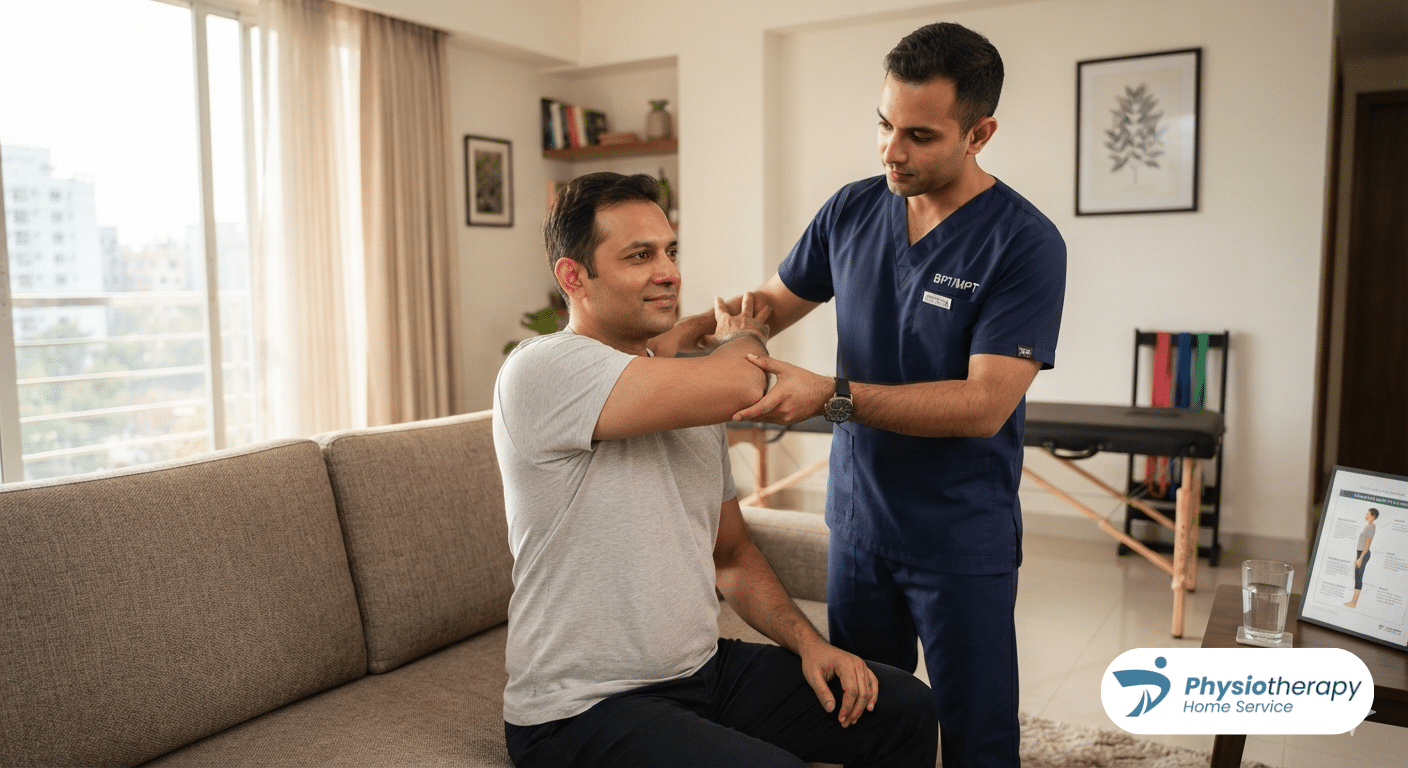
Authored by Senior Musculoskeletal Specialists. Discover how to overcome the agonizing range-of-motion losses of a stiff shoulder without the pain of traveling to crowded clinics.
Frozen Shoulder Anatomy and Pathology: Adhesive Capsulitis vs. Rotator Cuff Tears
To understand the reason for frozen shoulder, we must look at the frozen shoulder anatomy. The shoulder is a ball-and-socket joint surrounded by a capsule of connective tissue. When this capsule becomes inflamed and stiffens, it restricts movement. However, to provide effective treatment, an expert clinician must first achieve an accurate frozen shoulder diagnosis, differentiating between various shoulder pathologies. A misdiagnosis can lead to incorrect frozen shoulder exercises that further tear delicate tendons.
Adhesive Capsulitis (Frozen Shoulder)
Characterized by a global loss of both active and passive range of motion. The joint capsule thickens and develops adhesions. Adhesive capsulitis rehab focuses on breaking down these adhesions through graded manual mobilization and joint glides.
Rotator Cuff Injuries (Frozen Shoulder Muscles)
Involves a tear or strain in the four frozen shoulder muscles (supraspinatus, infraspinatus, teres minor, subscapularis) supporting the joint. Proper rotator cuff tear home care avoids heavy stretching and prioritizes isometric strengthening and tendon healing.
Bursitis & Impingement
Shoulder bursitis relief and shoulder impingement treatment are required when the fluid-filled sac (bursa) or tendons are pinched beneath the acromion bone during overhead movements, causing a painful “catching” sensation.
Primary Frozen Shoulder Causes & The Diabetes Connection
What are the main frozen shoulder causes? While the exact cause is sometimes idiopathic (unknown), there are significant risk factors. The connection between frozen shoulder diabetes is particularly strong. People with diabetes are up to three times more likely to develop adhesive capsulitis. The exact reason is still being researched, but it’s believed that glucose molecules attach to the collagen in the shoulder capsule, causing it to build up and stiffen.
Other risk factors include prolonged immobility (e.g., after a stroke, surgery, or arm fracture) and systemic diseases like thyroid dysfunction. Understanding the reason for frozen shoulder is crucial for developing a targeted frozen shoulder treatment plan.
The Three Clinical Stages of Frozen Shoulder
As noted by authoritative medical bodies, a frozen shoulder progresses through three distinct stages. Your stage dictates the exact type of frozen shoulder physiotherapy at home in dhaka we will apply. If you are wondering how to treat frozen shoulder, it starts with identifying the correct stage.
| Stage | Duration | Clinical Symptoms | Home Physiotherapy Focus |
|---|---|---|---|
| 1. Freezing Stage | 6 weeks to 9 months | Severe, constant frozen shoulder pain, especially at night. Range of motion begins to steadily decline. | Pain management, gentle TENS therapy, soft tissue release, and avoiding aggressive stretching. Learning how to get rid of frozen shoulder pain is the priority here. |
| 2. Frozen Stage | 4 to 6 months | Pain may decrease, but stiffness peaks. Daily activities like dressing become nearly impossible. | Aggressive adhesive capsulitis rehab. Deep joint mobilizations, capsular stretching, and active-assisted range of motion. |
| 3. Thawing Stage | 6 months to 2 years | Shoulder mobility slowly improves. Strength deficits in the frozen shoulder muscles become obvious. | Strengthening the rotator cuff, proprioception drills, and returning to full functional activity using targeted frozen shoulder exercises. |
How to Treat Frozen Shoulder: Core Modalities & Home Care
Many patients ask, “how to get rid of frozen shoulder quickly?” or search for home remedies for frozen shoulder. While heat/cold packs offer temporary relief, clinical recovery requires structural changes to the joint capsule. Our certified BPT and MPT specialists arrive fully equipped with portable, hospital-grade technology and advanced manual skillsets to deliver the best frozen shoulder treatment.
1. Advanced Manual Mobilization
The cornerstone of adhesive capsulitis rehab is hands-on mobilization. We apply precise anterior, posterior, and inferior glides to the glenohumeral joint to stretch the tightened capsule. These micro-movements safely restore the “joint play” necessary for full arm elevation.
2. Rotator Cuff Tear Home Care & Tendon Repair Protocol
For partial tendon tears, we utilize deep transverse friction massage to align healing collagen fibers, combined with isometric resistance exercises. Our rotator cuff tear home care protocols ensure the delicate supraspinatus tendon strengthens without risking a full rupture.
3. Shoulder Impingement Treatment & Electrotherapy
To achieve rapid shoulder bursitis relief and effective shoulder impingement treatment, we bring portable Ultrasound Therapy and TENS units to your home. Ultrasound penetrates deep into the bursa, reducing localized swelling and flushing out inflammatory markers.
5 Frozen Shoulder Exercises for Quick Relief
Between our clinical visits, active patient participation is critical. Under our supervision, patients are taught specialized frozen shoulder exercises. Note: Never push through sharp pain; a mild stretching sensation is acceptable. Here are 5 frozen shoulder exercises for quick relief:
1. Pendulum Stretch
Lean over a table, letting your affected arm hang freely. Gently swing the arm in small circles using the momentum of your body. This decompresses the joint space.
2. Towel Stretch
Grasp a towel behind your back with both hands. Use your healthy arm to gently pull the affected arm upward, stretching the internal rotators.
3. Wall Walking
Stand facing a wall. Slowly walk your fingers up the wall as high as you comfortably can, holding the stretch at the top to improve flexion.
4. Cross-Body Reach
Use your good arm to lift your affected arm at the elbow, and bring it up and across your body, gently stretching the shoulder.
5. Pulley Exercises for Frozen Shoulder
Using an over-the-door pulley system, use your healthy arm to gently pull the affected arm upward. Pulley exercises for frozen shoulder are excellent for restoring passive range of motion in the later stages of recovery.
For individuals recovering from major orthopedic repairs, check our specific guide on post-surgical home physiotherapy recovery.
Understanding Frozen Shoulder in the Local Context
Many patients in Dhaka search for the frozen shoulder meaning in bengali to better understand their condition. In Bengali, it is often simply referred to as frozen shoulder bangla (ফ্রোজেন শোল্ডার) or “কাঁধের আড়ষ্টতা” (kandher aroshtota), which accurately describes the stiffness and pain associated with the condition. Explaining the condition in the patient’s native language helps demystify the diagnosis and ensures compliance with the frozen shoulder treatment plan.
Expert Physiotherapists Dispatched Across All Dhaka Neighborhoods
Timely intervention prevents a frozen shoulder from becoming a permanent disability. Our clinic is decentralized, meaning our certified experts are stationed across Dhaka for rapid dispatch to provide frozen shoulder physiotherapy at home in dhaka.
- Diplomatic & Commercial Zones: We provide rapid home care physiotherapist in gulshan and banani for busy corporate professionals suffering from desk-induced posture and impingement issues.
- Residential Hubs: For families and elderly patients, we dispatch highly trained professionals, including a female physiotherapist at home in dhanmondi to ensure utmost privacy and comfort during manual therapy.
- Northern Dhaka: We offer comprehensive uttara physiotherapy home service and mirpur care for post-surgical rotator cuff patients and chronic arthritis sufferers.
To view our full service map, read our comprehensive guide to physiotherapy home service in dhaka.
Frequently Asked Questions (FAQ)
1. Can frozen shoulder be cured completely with home physiotherapy?
Yes. With consistent, professionally guided adhesive capsulitis rehab at home, over 90% of patients regain full or near-full range of motion and complete pain relief without needing surgical intervention.
2. How long does frozen shoulder physiotherapy at home in dhaka take to work?
The timeline depends on your stage. Freezing stage pain management takes a few weeks, while thawing stage rehabilitation to restore full motion can take 3 to 6 months of dedicated therapy.
3. Is shoulder impingement treatment painful?
No. Our clinical approach focuses on pain-free mobilization and joint decompression. You may feel a slight stretch or muscle fatigue, but we do not push the joint into sharp pain.
4. What is the difference between frozen shoulder and a rotator cuff tear?
A frozen shoulder involves global stiffness (you physically cannot lift the arm even if someone else moves it). A rotator cuff tear involves profound weakness and pain upon lifting, but a therapist can usually move the arm passively. We provide specialized rotator cuff tear home care for the latter.
5. Are pulley exercises for frozen shoulder effective?
Yes, pulley exercises for frozen shoulder are highly effective in the later stages (frozen and thawing) for restoring passive range of motion safely, using the uninjured arm to assist the stiff arm.
6. What is the link between frozen shoulder and diabetes?
Frozen shoulder diabetes is a well-documented link. Diabetic patients are at a higher risk because excess glucose can attach to collagen in the shoulder capsule, making it stiffen more easily.
7. Do you bring equipment to my house?
Absolutely. Our physiotherapists carry medical-grade TENS units, portable Ultrasound machines, resistance bands, kinesiology tape, and mobilization belts.
8. How do you confirm a frozen shoulder diagnosis?
A clinical frozen shoulder diagnosis is primarily made through a physical examination, assessing the specific patterns of restricted active and passive movement, ruling out other issues like arthritis or severe rotator cuff tears.
9. Do you offer female physiotherapists for female patients?
Yes, we have specialized female professionals. You can specifically request a female physiotherapist at home in dhanmondi, Gulshan, or any other Dhaka area for total comfort.
10. Are your physiotherapists certified?
Yes, all our professionals hold a Bachelor of Physiotherapy (BPT) or Master of Physiotherapy (MPT) from recognized medical universities and are registered practitioners.