
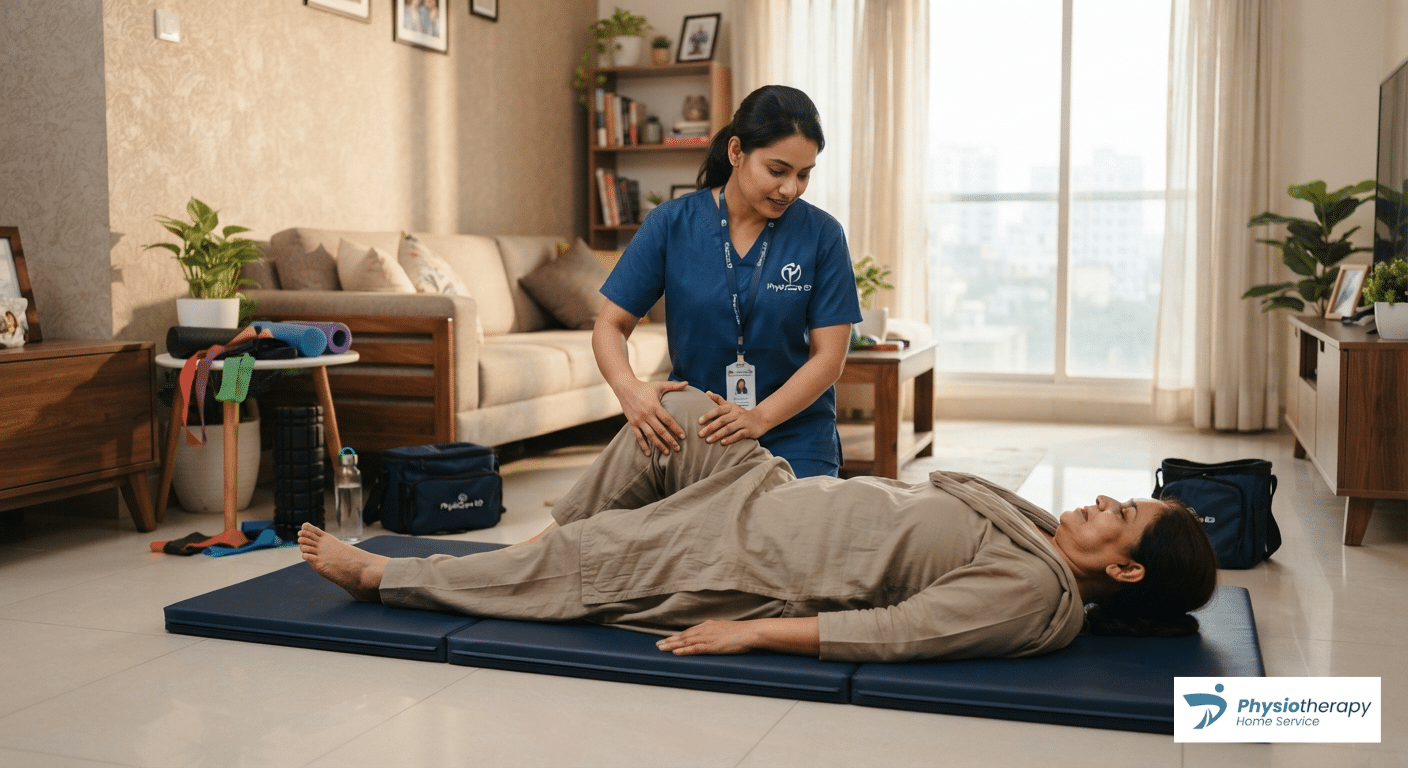
Clinical Approach to Hip & Pelvic Pain Management at Home
Understanding Pelvic Misalignment
Pelvic misalignment and sacroiliac (SI) joint dysfunction frequently disrupt your natural gait. Consequently, simple daily movements like walking down stairs or standing become painful challenges. In addition, when the kinetic chain between the pelvis and femur is compromised, compensating muscle groups become fatigued. As a result, secondary conditions like gluteal tendinopathy develop quickly.
Why Choose At-Home Rehabilitation?
Accessing expert care in a clinical setting can worsen acute hip strain due to travel friction. Therefore, booking a specialized hip pain physiotherapy home service in dhaka allows patients to receive advanced manual therapy directly at home. Ultimately, this protects damaged tissues from unnecessary aggravation caused by traffic stress.
“A patient can undergo perfect manual alignment in a clinic, but returning home to sit on a saggy sofa will undo that progress overnight. Home-based care allows us to correct both the body and the environment simultaneously.”
Restoring Biomechanics: Sacroiliac Joint Dysfunction Care & Pelvic Alignment Therapy
Sacroiliac Joint Mechanics
The sacroiliac joint acts as the central shock absorber for your body. However, micro-trauma or muscular imbalances can cause this joint to lock. Consequently, your body compensates by tilting the pelvis unevenly during movement.
Pelvic Realignment Techniques
Through targeted sacroiliac joint dysfunction care, a mobile physical therapist applies gentle joint mobilization to restore pelvic symmetry. Furthermore, integrating targeted pelvic alignment therapy stabilizes key core muscles like the transverse abdominis. As a result, this creates a dynamic muscle girdle that locks the pelvis into proper alignment.
Environmental Audits: Mattress and Seating Optimization for Hip Bursitis Relief
Eliminating Ergonomic Pressure Factors
Treating deep hip inflammation requires eliminating repetitive pressure micro-traumas. Specifically, conditions like trochanteric bursitis demand targeted hip bursitis relief strategies that extend to your home environment.
Key Home Assessment Items
- Mattress Firmness: A mattress that is too soft allows the pelvis to sink unevenly. Consequently, this places excessive lateral tension on the IT band throughout the night.
- Seating Ergonomics: Low, plush couches force the hips into hyper-flexion below 90 degrees. As a result, this increases compressive forces on the hip joint capsule.
- Sleeping Postures: Furthermore, implementing side-sleeping protocols with targeted bolster placement between the knees reduces strain across the upper hip joint.
Additionally, for peer-reviewed data on joint rehabilitation standards, refer to the guidelines published by the Journal of Orthopaedic & Sports Physical Therapy (JOSPT).
Progressive Stabilization: Hip Impingement Home Rehab Protocols
Managing Structural Impingement
For structural challenges like Femoroacetabular Impingement (FAI), structured hip impingement home rehab focuses on restoring joint clearance. Additionally, it trains deep hip rotators to control femoral head alignment properly.
| Rehab Phase | Primary Objective | Focus Exercises & Manual Interventions |
|---|---|---|
| Phase 1: Acute Decompression | Inflammation control & joint decompression | Psoas release, gentle passive range of motion, mattress correction |
| Phase 2: Dynamic Stabilization | Pelvic girdle control & activation | Isometric glute bridges, side-lying clam shells with elastic bands |
| Phase 3: Functional Gait Control | Weight-bearing stability & endurance | Step-up controls, eccentric hip abduction, dynamic balance drills |
Addressing Co-existing Pain
Moreover, patients experiencing concurrent lumbar discomfort can explore how physiotherapy home service is better for multi-joint strain and chronic lower limb recovery.
Frequently Asked Questions (FAQ)
1. How does a physiotherapist diagnose SI joint dysfunction at home?A physiotherapist conducts clinical provocation tests directly in your home. For instance, they perform Patrick’s (FABER) test while analyzing your gait on your home flooring.
2. Is pelvic alignment therapy safe to perform at home?Yes, it is entirely safe. When guided by a certified therapist, pelvic alignment therapy utilizes low-velocity muscle energy techniques tailored to your comfort level.
3. How do hip bursitis relief techniques differ from hip impingement rehab?Hip bursitis relief focuses primarily on reducing lateral compression and modifying sleeping posture. Conversely, hip impingement home rehab emphasizes restoring joint clearance and rotator control.
4. Why choose home physiotherapy in Dhaka over a traditional clinic?Navigating Dhaka traffic with acute hip pain often worsens tissue inflammation. Therefore, home therapy eliminates transit trauma while allowing direct assessment of your seating ergonomics.
5. Can home physiotherapy resolve pelvic girdle pain after pregnancy?Yes, effectively. Postpartum pelvic pain often stems from joint laxity. Consequently, home care provides targeted core re-education and SI joint stabilization tailored to your routine.
6. What modifications will a physio suggest for my mattress?Your therapist assesses mattress firmness carefully. Subsequently, they recommend strategic bolster alignment between your knees to hold the pelvis in a neutral position overnight.
7. How quickly can I expect hip bursitis relief with home care?Most patients experience noticeable relief within 3 to 6 sessions. However, this relies on eliminating compressive pressure factors and following prescribed home stretches.
8. What equipment is required for hip impingement home rehab?No complex machinery is needed. Specifically, mobile physiotherapists bring resistance bands and foam rollers, adapting your existing home furniture for progressive strength exercises.
9. How do I know if pain originates from my hip or back?Hip joint pain typically presents in the groin or front thigh. In contrast, back pain usually radiates into the glutes down the back of the leg.
10. How do I book a specialized hip pain home assessment?You can schedule a consultation directly through our website. As a result, a senior musculoskeletal specialist will be dispatched promptly to your residence.