
The Growing Challenge of Severe Knee Pain in Dhaka
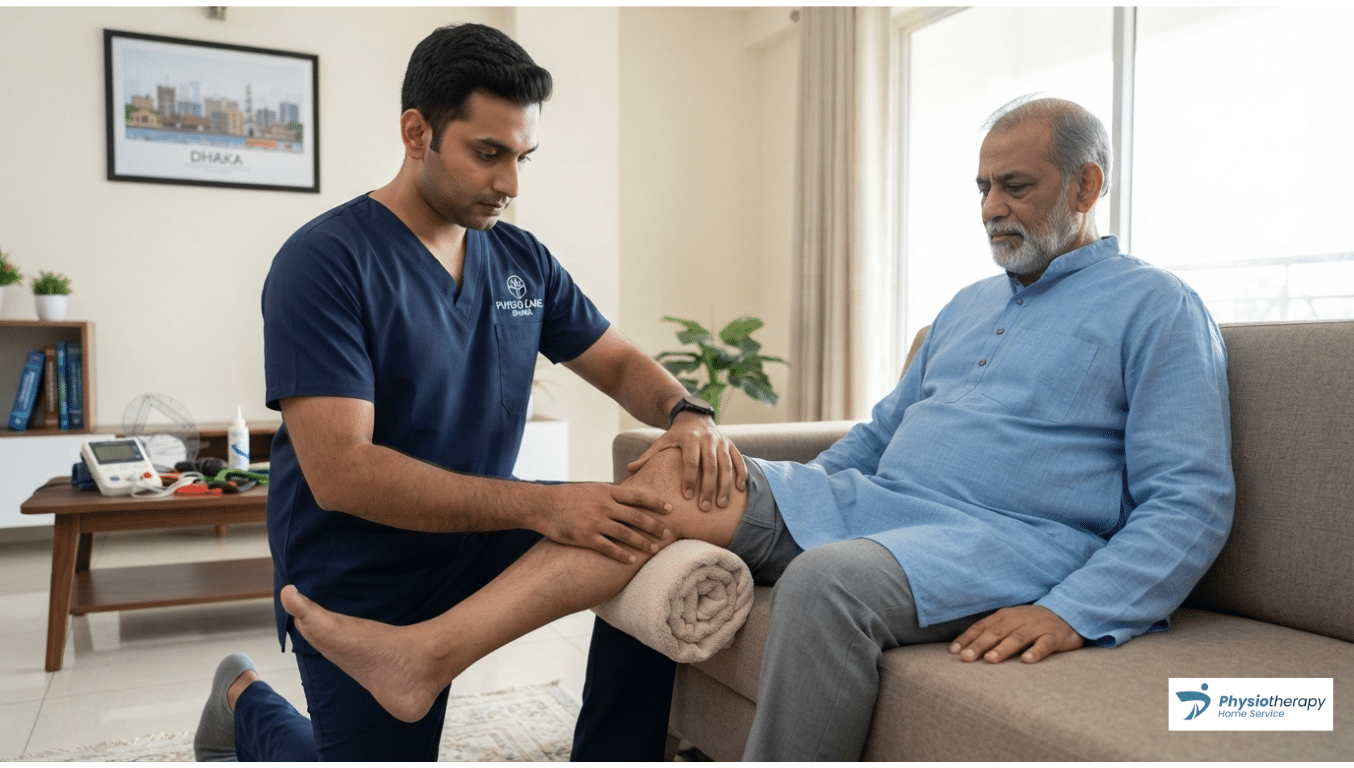
From aging adults suffering from progressive knee osteoarthritis to young athletes facing complex ACL tears and meniscus damage, knee dysfunction severely impairs basic mobility and independent living.
For individuals dealing with severe knee joint pain or acute ligament trauma, traveling through Dhaka’s congested traffic is often counterproductive to clinical recovery.Stepping up high bus platforms, negotiating uneven footpaths, or enduring constant vehicular vibrations in CNGs and cars subjects an inflamed knee joint to harmful shock loads.
Every sudden bump can aggravate articular cartilage degeneration or worsen a fragile ligament tear.
This reality makes securing a dedicated knee pain physiotherapy home service in dhaka an essential medical strategy.
Bringing university-certified BPT and MPT doctors directly to your home eliminates commuting risks, prevents premature joint load, and delivers institutional-grade rehabilitation in your private space.
To explore our broader home clinical offerings, read our primary guide on physiotherapy home service in dhaka or review specialized support via our musculoskeletal therapy home service.
Anatomical Causes of Knee Pain and Indications for Home Care
Understanding exact knee pain causes is the first critical step toward long-term functional recovery. The knee is a complex, weight-bearing hinge joint reliant on articular cartilage, meniscus shock-absorbers, and stabilizing ligaments (ACL, PCL, MCL, LCL) working in synergy.
When these structures break down, patients experience chronic stiffness, swelling, clicking sounds, and localized instability. Our in-home clinical assessments focus on pinpointing these specific mechanical disruptions:
- Osteoarthritis Knee Care: Progressive thinning of hyaline cartilage leads to bone-on-bone friction. Our home therapy programs emphasize joint decompression, patellar glides, and periarticular muscle strengthening.
- ACL Recovery at Home: Post-surgical or conservative management for Anterior Cruciate Ligament sprains and tears requires strict range-of-motion control, swelling management, and gradual quadriceps re-education.
- Meniscus Tear Physical Therapy: Medial or lateral meniscus tears cause mechanical locking and sharp joint line pain. We apply targeted non-weight-bearing mobilization to protect tearing edges while restoring mobility.
- Patellofemoral Pain Relief: Frequently caused by abnormal tracking of the kneecap along the femur, resulting in anterior aching. Customized vastus medialis obliquus (VMO) strengthening effectively corrects tracking errors.
Clinical Protocols: Quadriceps Activation and Protecting Joint Cartilage
During early post-injury recovery or acute arthritic flare-ups, mechanical management is paramount. A fundamental rule emphasized by our orthopedic team is **avoiding stairs during early post-injury phases**. Climbing or descending stairs forces the knee joint to absorb forces up to 3 to 4 times a person’s total body weight, which damages healing articular surfaces and irritates torn ligamental fibers.
By bringing a certified **knee pain treatment** specialist to your doorstep, we manage early-stage rehabilitation through controlled isometric protocols before introducing functional weight-bearing:
- Straight Leg Raises (SLR): Isolating the quadriceps without applying compressive loads across the patellofemoral joint.
- Terminal Knee Extensions (TKE): Targeted terminal extension work to activate the VMO and stabilize the knee cap.
- Gentle Manual Mobilization: Grade I-II patellar and tibiofemoral glides administered by expert hands to relieve pain and enhance synovial fluid movement.
When patients inquire about relying solely on daily knee joint pain medicine, our medical team highlights that pharmaceutical pain management should only serve as a temporary bridge. While anti-inflammatory medications suppress pain symptoms, targeted physical rehabilitation resolves underlying structural weakness, biomechanical imbalance, and joint stiffness.
Evidence-Based Exercise for Knee Joint Pain at Home
A structured, progressive **exercise for knee joint pain** plan is necessary to rebuild strength without causing joint irritation. Below is a clinical progression matrix used by our BPT/MPT visiting specialists:
| Recovery Stage | Primary Therapeutic Goal | Targeted In-Home Exercises |
|---|---|---|
| Phase 1: Acute / Protection | Reduce swelling & preserve quad muscle firing | Quad sets, ankle pumps, supine heel slides, isometric hamstring sets |
| Phase 2: Sub-Acute Rehab | Restore full extension & build static strength | Straight leg raises (4-way), seated terminal knee extensions, hip abduction |
| Phase 3: Functional Loading | Proprioception, balance & dynamic control | Wall sits, shallow mini-squats, step-ups (controlled), single-leg balance |
Every movement sequence is directly supervised by your home physical therapist to verify precise biomechanics and prevent compensatory movement patterns.
Frequently Asked Questions (FAQ)
1. Why should I choose knee pain physiotherapy home service in dhaka instead of visiting a clinic?
In-home service completely eliminates the stress and physical impact of traveling through Dhaka’s heavy traffic. It protects your vulnerable joint cartilage from road vibrations and stairs while providing focused, one-on-one attention from a certified physical therapist.
2. What causes severe knee pain when bending or climbing stairs?
Pain during bending or stair climbing typically points to patellofemoral pain syndrome, meniscus damage, or advanced knee osteoarthritis. The high joint compression forces created during these activities irritate inflamed joint structures.
3. Is home physical therapy effective for complete ACL recovery at home?
Yes. Early and mid-stage ACL rehabilitation—focusing on knee extension, quadriceps re-education, swelling control, and gait retraining—can be safely performed at home using portable physical equipment and manual therapy.
4. Can exercise for knee joint pain replace long-term knee joint pain medicine?
While medication reduces short-term inflammation, targeted exercise builds supporting muscle strength and improves joint mechanics, addressing the root cause of chronic pain for lasting relief without pharmaceutical dependence.
5. How does a therapist evaluate knee joint pain causes during a home visit?
Your visiting therapist performs comprehensive orthopedic testing, including range-of-motion measurements, ligament stability tests (Lachman, anterior drawer), patellar tracking assessments, and functional strength evaluations in your living space.
6. What specialized equipment do therapists bring for home knee care?
Our visiting doctors carry portable electrotherapy units (TENS, IFT, ultrasound), resistance bands, goniometers for precise angle tracking, balance pods, and ice/heat therapy packs.
7. Can elderly patients with severe knee osteoarthritis receive safe home treatment?
Yes. Our therapists specialize in gentle, low-impact geriatric protocols that reduce arthritic stiffness, improve joint lubrication, and restore safe walking stability within the home environment.
8. How many home therapy sessions are required for noticeable knee pain treatment results?
Most patients experience measurable pain reduction and improved mobility within 4 to 6 sessions, while full structural recovery programs generally range from 8 to 12 structured visits.
9. Is a torn meniscus manageable without surgery using home therapy?
Many degenerative or minor meniscus tears respond very well to conservative management. Targeted physical therapy strengthens surrounding muscles and restores stability without surgical intervention.
10. How do I schedule a professional knee pain physiotherapy home visit in Dhaka?
You can call our clinical helpline or send a WhatsApp message to book a consultation. Our care coordination team will assign a university-certified therapist to visit your residence at your preferred time.
Take the First Step Toward Pain-Free Mobility Today
Living with chronic knee joint pain treatment needs or recovering from a severe sports injury does not mean suffering in silence or risking further joint damage in city traffic.
By choosing professional knee pain physiotherapy home service in dhaka, you receive specialized, university-certified physical medicine in the safety and comfort of your home.
Contact our clinical coordination team today to book your comprehensive home knee evaluation.