
Repetitive Strain Injuries in Dhaka
Modern corporate life in hubs like Gulshan, Banani, Motijheel, and Uttara, coupled with intensive home-making tasks, has triggered an epidemic of upper limb musculoskeletal disorders.
Long hours spent typing on mechanical keyboards, navigating trackpads, scrolling smartphones, and gripping kitchen tools place continuous, micro-traumatic stress on the tendons and nerves of the upper extremities. When these repetitive micro-tears outpace the body’s natural healing capacity, Repetitive Strain Injuries (RSIs) set in.
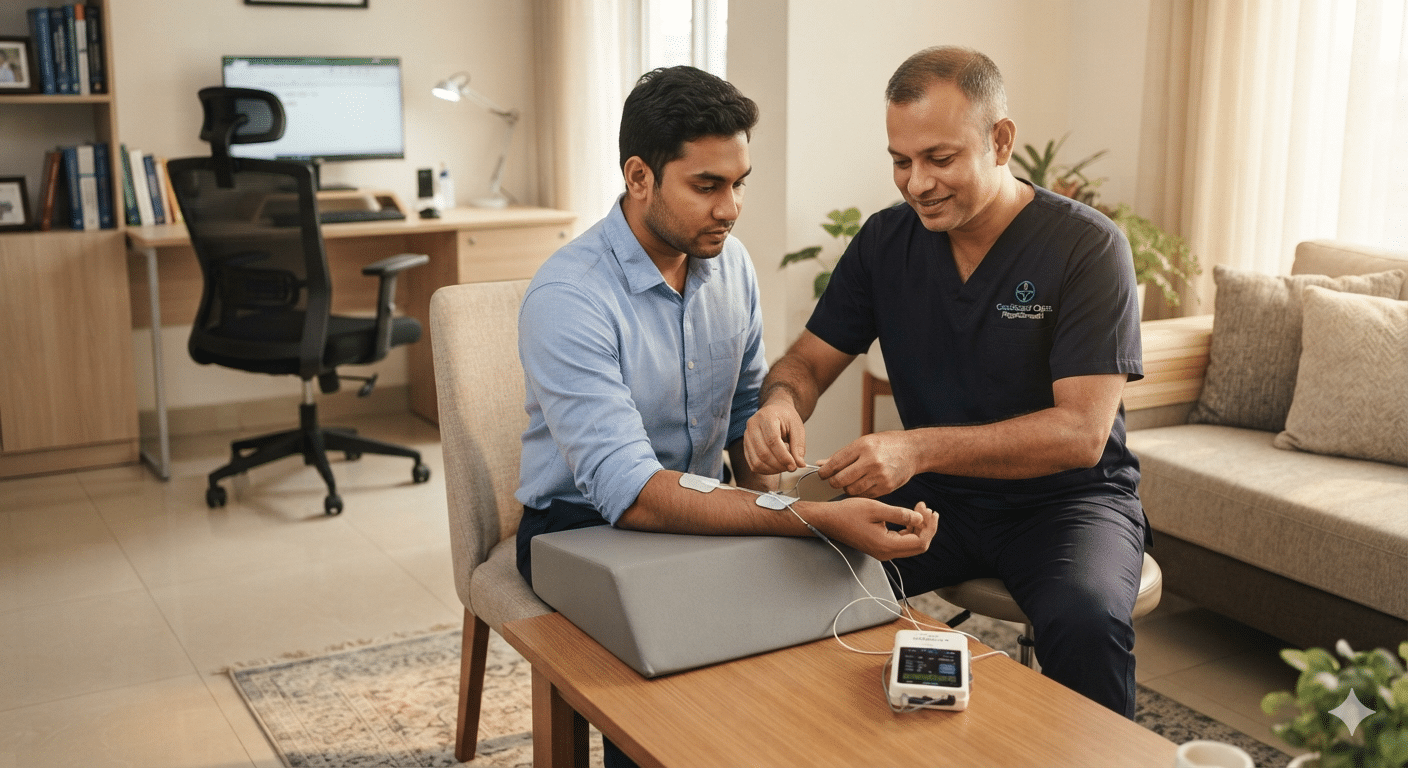
For professionals and home-makers alike, traveling through heavy city traffic to visit a traditional clinic often aggravates chronic tendonitis. Consequently, seeking professional tennis elbow treatment at home in dhaka provides a practical, stress-free clinical solution.
By bringing certified musculoskeletal experts directly to your residence, you eliminate commute-induced muscle guarding and receive targeted rehabilitation in the exact environment where your injury occurs.
Understanding the Anatomy of RSI: Elbow, Wrist & Hand Pathologies
Repetitive strain injuries do not happen overnight; they are cumulative disorders affecting tendons, nerves, and surrounding soft tissues. Recognizing the specific anatomical structures involved is essential for effective recovery.
Lateral Epicondylitis (Tennis Elbow)
Lateral epicondylitis involves the degeneration of the extensor carpi radialis brevis (ECRB) tendon where it attaches to the lateral epicondyle of the humerus.
Despite its name, most sufferers are office workers, writers, and individuals engaging in repetitive gripping or mouse navigation rather than tennis players. In addition, symptoms include sharp pain on the outer elbow, weak grip strength, and radiating forearm ache.
Therefore, accessing specialized musculoskeletal physiotherapy home service in dhaka ensures you receive precise treatment.
Medial Epicondylitis (Golfer’s Elbow)
Medial epicondylitis affects the flexor-pronator muscle origin on the inner side of the elbow. It is frequently seen in individuals who perform repetitive wrist flexion or forceful pronation.
Our ultimate guide to physiotherapy home service in dhaka highlights how targeted electrotherapy and ultrasound can dramatically accelerate soft tissue healing for medial tendonitis right at your living room desk.
Carpal Tunnel Syndrome & Desk Worker Wrist Pain
Compression of the median nerve as it passes through the carpal tunnel in the wrist leads to numbness, tingling, and burning sensations in the thumb, index, and middle fingers.
Desk workers who maintain unsupported wrist extension face a high risk of carpal tunnel syndrome. However, early intervention prevents permanent nerve damage.
The Clinical Advantages of At-Home RSI Rehabilitation
Managing chronic tendonitis requires consistency, patient education, and environmental modification. Clinical data proves that receiving therapy at home offers distinct therapeutic advantages over traditional clinic visits:
- Elimination of Commute Stress: Navigating Dhaka traffic immediately after a manual therapy session can cause cervical and shoulder tension, counteracting the relaxation achieved during treatment.As a result, At-home care preserves therapeutic outcomes.
- Contextual Workstation Audits: In addition, a licensed specialist evaluates your actual home office setup, kitchen counter height, and seating posture to make immediate ergonomic corrections.
- Personalized Attention: Furthermore, home-based sessions offer one-on-one, uninterrupted clinical focus, uninterrupted clinical focus, ensuring every eccentric stretch and electrotherapy application is executed with pinpoint accuracy.
You can learn more about these benefits through our detailed overview of the clinical advantages of physiotherapy at home and explore why a physiotherapy home service is better for chronic repetitive strain recovery.
Targeted Electrotherapy Technologies: TENS and IFT at Your Doorstep
Modern mobile physiotherapy units bring institutional-grade electromedical modalities directly to your home. When dealing with acute RSI flare-ups, two primary modalities are utilized:
Transcutaneous Electrical Nerve Stimulation (TENS)
TENS units deliver low-voltage electrical currents near the pain site. Based on the Gate Control Theory of Pain, these signals block pain impulses. Moreover, TENS stimulates the release of endorphins for natural relief.
It also stimulates the release of endogenous endorphins, providing natural analgesia for RSI hand pain relief.
Interferential Therapy (IFT)
Interferential Therapy utilizes two medium-frequency alternating currents that cross paths within the deep tissues of the elbow or wrist.
The intersection creates a low-frequency interference wave that penetrates deeper than standard TENS, reducing localized edema, decreasing muscle spasm, and accelerating cellular repair in chronic tendon fibers.
IFT is a cornerstone treatment for stubborn golfer elbow physical rehab.
Conducting a Comprehensive Home Workstation Audit for Desk Workers
Preventing recurrent strain starts with optimizing your physical workspace. Poor ergonomics places constant isometric loads on forearm extensors and flexors. Follow this checklist to audit your desk environment:
- Chair Height & Lumbar Support: Adjust your chair so your feet rest flat on the floor, with knees bent at a 90-degree angle. Ensure lumbar support maintains your lower spine’s natural curve.
- Monitor Position: The top third of your computer screen should be at eye level, positioned approximately an arm’s length away to prevent forward head posture that indirectly strains upper limb nerves.
- Keyboard and Mouse Placement: Keep your keyboard and mouse close enough that your elbows stay bent at a 90-to-100-degree angle close to your body. Avoid reaching forward, which forces continuous shoulder and forearm contraction.
- Wrist Neutrality: Use ergonomic keyboard trays or gel wrist rests to ensure your wrists remain in a neutral, straight position—avoiding excessive extension that triggers desk worker wrist pain.
Step-by-Step Home Exercises for Tennis Elbow and RSI Recovery
Rehabilitation must include progressive loading to remodel damaged collagen fibers. Always consult a certified professional before starting any regimen.
1. Eccentric Wrist Extension (Tyler Twist Adaptation)
Execution: First, Hold a light dumbbell or a flexible rubber bar in your affected hand. Next , Use your opposite hand to assist your wrist into full extension. Slowly lower the weight using only the affected wrist over a 4-to-5-second count.
Sets & Reps: 3 sets of 10 repetitions daily. This is vital for rebuilding tendon tensile strength during tennis elbow treatment at home in dhaka.
2. Finger Extensor Stretch with Rubber Band
Execution: Secondly, Place a light rubber band around all five fingers. Slowly expand your fingers outward against the resistance, hold for 3 seconds, and return to the center.
Sets & Reps: 2 sets of 15 repetitions to balance out gripping muscle dominance.
3. Nerve Gliding for Carpal Tunnel Relief
Execution: Start with an upright hand open, make a fist, bend your wrist backward gently, and extend your fingers upward.
Sets & Reps: Finally, Perform 10 smooth cycles to relieve median nerve tension associated with carpal tunnel syndrome therapy.
Neighborhood Coverage Across Dhaka
Our specialized musculoskeletal and RSI mobile teams provide prompt clinical dispatch across all major residential and commercial sectors in the metropolitan area:
- Gulshan & Banani: Dedicated home care specialists available for corporate executives experiencing home care physiotherapist in gulshan and banani 2.
- Dhanmondi: Tailored private sessions featuring options for a female physiotherapist at home in dhanmondi.
- Uttara & Mirpur: Rapid response units covering uttara physiotherapy home service and mirpur care.
Regional Physiotherapy Network Coverage
-
- Explore our broader network guides including the top 10 clinics for musculoskeletal physiotherapy at home in dhaka
- Our comprehensive overview of the comprehensive guide to physiotherapy home service bd expert care across all dhaka neighborhoods.
Frequently Asked Questions (FAQ)
1. What is the most effective tennis elbow treatment at home in Dhaka? The most effective home treatment combines professional manual soft tissue mobilization, targeted electrotherapy (TENS/IFT), ergonomic workspace adjustment, and progressive eccentric strengthening supervised by a certified BPT/MPT physiotherapist.
2. Can I get electrotherapy like IFT and TENS delivered to my home in Dhaka? Yes, our licensed mobile physiotherapy units bring portable, hospital-grade IFT and TENS machines directly to your home for effective pain management and soft tissue healing.
3. How long does it take to recover from tennis elbow with home physiotherapy? Mild cases of lateral epicondylitis often improve within 4 to 6 weeks of consistent home care, while chronic or severe tendinopathy may require 8 to 12 weeks of structured rehabilitation.
4. What are the early signs of carpal tunnel syndrome for desk workers? Early warning signs include intermittent numbness, tingling, or a “pins and needles” sensation in the thumb, index, and middle fingers, particularly during morning hours or after prolonged typing.
5. Is home physiotherapy safe and effective for golfer’s elbow? Absolutely. Home physiotherapy provides targeted flexor tendon rehabilitation, ultrasound therapy, and customized stretching protocols tailored specifically to medial epicondylitis.
Common Questions About At-Home Physiotherapy
6. Do I need any special equipment for at-home RSI rehabilitation? No special equipment is required initially. Your physiotherapist brings all necessary electromedical devices (TENS/IFT) and prescribes simple home items like resistance bands or light weights.
7. How do I book a musculoskeletal specialist for RSI treatment in Gulshan? You can easily schedule an appointment through our booking portal for prompt dispatch of a home care physiotherapist in gulshan and banani 2.
8. Why is home physiotherapy better than visiting a clinic for wrist and elbow pain? Home therapy saves you from stressful Dhaka traffic commutes that aggravate arm pain, allows for a direct assessment of your home workstation, and provides distraction-free one-on-one care.
9. Can home-makers also suffer from tennis elbow? Yes, home-makers frequently develop tennis elbow due to repetitive gripping, lifting heavy pots, wringing clothes, and continuous wrist movements during domestic chores.
10. What lifestyle changes complement RSI physical therapy? Taking micro-breaks every 30 minutes, maintaining proper wrist alignment while typing, performing regular forearm stretches, and ensuring adequate hydration significantly complement physical therapy.