
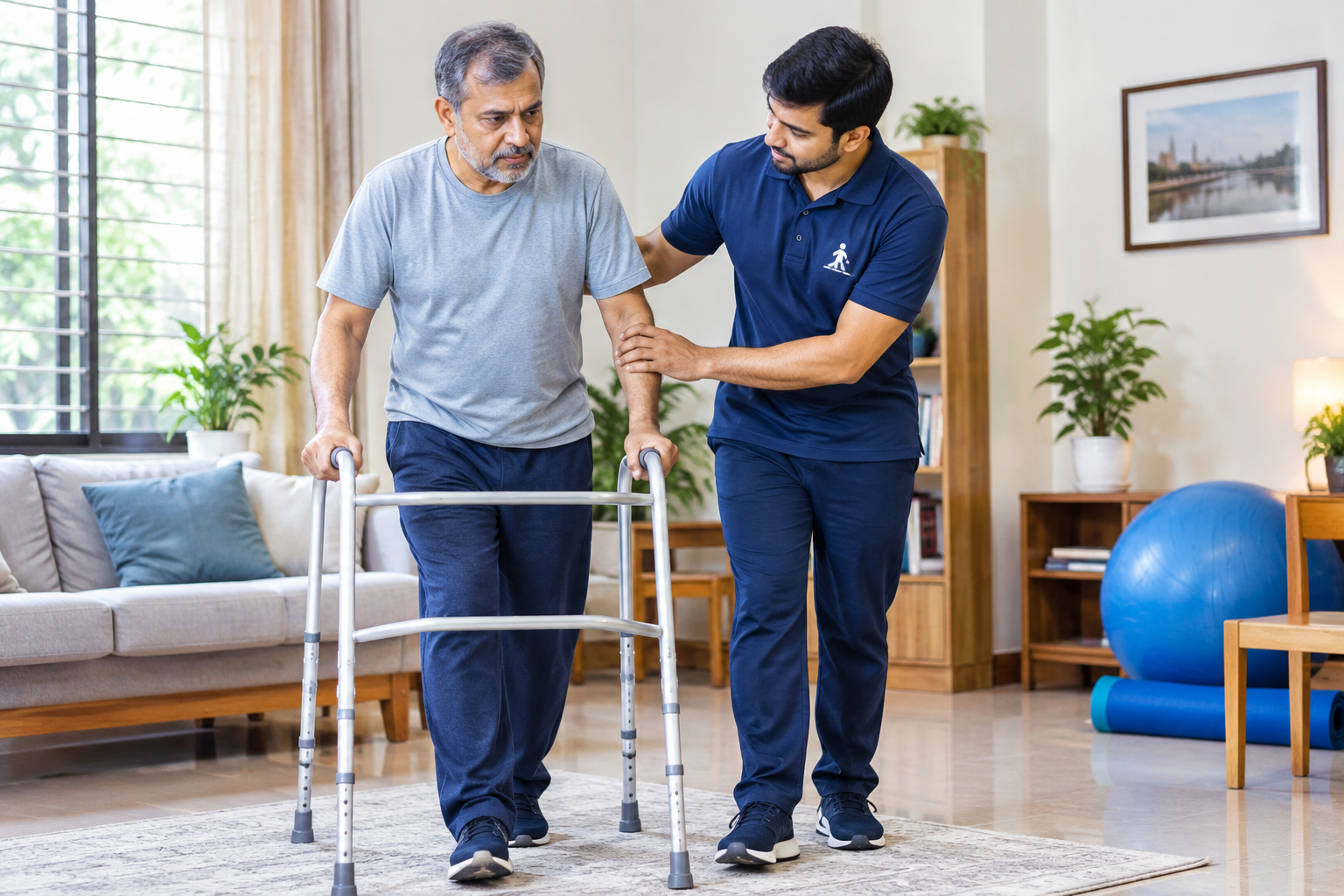
Walking difficulties are common after a stroke. A person may experience weakness on one side of the body, reduced balance, difficulty placing the foot correctly, stiffness, or reduced confidence while walking.
Stroke walking rehabilitation focuses on improving movement, balance, strength, coordination, and functional walking skills. With appropriate assessment and a rehabilitation plan, physiotherapy can help a person work toward safer and more independent movement.
What Happens to Walking After a Stroke?
A stroke can affect parts of the brain responsible for movement, balance, and coordination. Depending on the area affected and the severity of the stroke, walking ability can change significantly.
Muscle Weakness
Weakness in the leg or one side of the body can make standing, stepping, and walking more difficult.
Balance Difficulties
Reduced balance can make it harder to maintain a stable position while standing or changing direction.
Changes in Walking Pattern
A person may develop an uneven walking pattern, shorter steps, or difficulty clearing the foot from the ground.
Reduced Coordination
Stroke can affect the coordination needed to move the hip, knee, and ankle during walking.
Why Is Walking Rehabilitation Important After Stroke?
Walking rehabilitation is an important part of many stroke rehabilitation programs. Treatment is usually based on the person’s current abilities, medical condition, and functional goals.
Physiotherapy may focus on improving lower-limb movement, standing control, balance, strength, coordination, and the ability to perform everyday walking activities.
For broader neurological rehabilitation, learn more about our neurological physiotherapy in Dhaka.
Common Walking Problems After Stroke
- Difficulty standing without support
- Difficulty taking or controlling steps
- Weakness in one leg
- Difficulty lifting or clearing the foot
- Uneven walking pattern
- Difficulty maintaining balance
- Difficulty turning while walking
- Reduced walking endurance
- Difficulty using stairs
Stroke Walking Rehabilitation Exercises
Exercises should be selected according to the individual’s condition and ability. A physiotherapist may use different activities to address specific walking and movement difficulties.
1. Sit-to-Stand Practice
Practising controlled movement between sitting and standing can help address lower-limb strength and functional movement.
2. Weight-Shifting Exercises
Controlled weight shifting from one side to another can be used as part of balance and standing training.
3. Supported Standing
Standing with appropriate support may help a person practise posture, balance, and lower-limb control.
4. Step Practice
A physiotherapist may introduce controlled stepping exercises based on the person’s current walking ability.
5. Gait Training
Gait training focuses on practising the components of walking, such as foot placement, step length, balance, and movement control.
Important Safety Considerations
Not every stroke survivor should perform the same exercises. Exercises that are appropriate for one person may not be suitable for another.
Walking exercises should be performed according to professional assessment, especially when balance or mobility is significantly impaired.
Balance and Weight-Shifting After Stroke
Balance is an important part of walking rehabilitation. A person needs to control their body while standing, transferring weight, and taking steps.
Depending on the person’s abilities, rehabilitation may include supported standing, controlled weight shifting, reaching activities, stepping practice, and functional balance exercises.
These activities should be progressed gradually and performed in a safe environment.
Gait Training After Stroke
Gait training is the process of practising walking and the movements that contribute to a functional walking pattern.
Step Control
Training may focus on controlled placement of each foot during walking.
Walking Speed and Endurance
Walking speed and endurance can be addressed according to the person’s current ability and rehabilitation goals.
Direction Changes
Turning and changing direction can be practised as functional walking skills.
Walking Distance
Walking distance may be gradually adjusted according to tolerance and rehabilitation goals.
Using Walking Aids After Stroke
Some stroke survivors may require a walking aid during rehabilitation. Depending on the individual’s needs, this may include a cane, walker, or another appropriate mobility aid.
The correct type and use of a walking aid should be assessed by a qualified healthcare professional. Incorrect use can affect balance and walking safety.
Stroke Walking Rehabilitation at Home in Dhaka
Home-based rehabilitation can be useful for people who have difficulty travelling to a clinic. A physiotherapist can assess movement and walking within the person’s normal home environment.
Home rehabilitation may include:
- Movement and mobility assessment
- Standing and balance practice
- Walking and gait training
- Lower-limb strengthening
- Functional movement practice
- Home exercise guidance
- Walking-aid assessment
- Caregiver education
You can also learn more about our stroke rehabilitation at home in Dhaka.
What Can a Physiotherapist Assess?
During a stroke rehabilitation assessment, a physiotherapist may examine several aspects of movement and function, including:
- Lower-limb strength
- Joint movement
- Standing balance
- Walking pattern
- Coordination
- Transfers and functional mobility
- Walking endurance
- Use of mobility aids
- Ability to perform everyday movements
How Caregivers Can Support Stroke Walking Rehabilitation
Family members and caregivers can play an important role in supporting a person’s rehabilitation plan.
- Help the patient follow the rehabilitation plan provided by the healthcare professional.
- Keep walking areas clear of unnecessary obstacles.
- Encourage appropriate rehabilitation activities.
- Follow the physiotherapist’s instructions for exercises.
- Monitor changes in walking, balance, pain, or mobility.
- Communicate significant changes to the patient’s healthcare team.
When Should You Seek Medical Attention?
Stroke rehabilitation should be coordinated with the patient’s medical team. Seek urgent medical attention if a person develops sudden new neurological symptoms or a significant change from their usual condition.
Symptoms such as sudden weakness, facial drooping, difficulty speaking, severe dizziness, or sudden loss of coordination require urgent medical assessment.
Frequently Asked Questions
Can physiotherapy help with walking after a stroke?
Physiotherapy can be part of stroke rehabilitation and may focus on strength, balance, coordination, transfers, and walking practice. Progress varies between individuals.
Can stroke walking rehabilitation be done at home?
Yes. Depending on the person’s medical condition and mobility level, rehabilitation activities can be provided at home by a qualified physiotherapist.
What exercises are used after a stroke?
Exercises may include sit-to-stand practice, balance activities, weight shifting, stepping, and gait training. The appropriate exercises depend on the individual’s assessment.
How long does stroke walking rehabilitation take?
Recovery time varies significantly depending on factors such as the severity of the stroke, affected functions, general health, and participation in rehabilitation.
Can a physiotherapist provide stroke rehabilitation at home in Dhaka?
Home physiotherapy may be available for patients who prefer or require rehabilitation at home. You can contact Physiotherapy Home Service BD to discuss the patient’s rehabilitation requirements.
Related Physiotherapy Services
Neurological Physiotherapy in Dhaka
Book a Physiotherapy Appointment
Stroke Rehabilitation at Home in Dhaka
If you or a family member needs home-based stroke rehabilitation, contact our team to discuss the patient’s condition and rehabilitation requirements.